


Research grounded in a real problem
From a research problem to a solution ready for implementation
An innovative project does not begin with choosing a technology. It begins with a well-defined problem that cannot be solved simply by applying products or standard methods already available on the market.
At Infotower Business Solutions, we conduct and support research and development primarily in healthcare, artificial intelligence, data analysis and process automation. We bring together scientists, analysts, domain experts and software engineers to take a project from a research hypothesis and experiment to a prototype and deployment in a real environment.
We do not stop at a concept or research report. Our objective is a solution that can be verified, integrated with existing systems and used in an organisation's day-to-day work.
- 01Problem
Users, process, data and technological uncertainty.
- 02Research
Hypotheses, experiments, metrics and documented results.
- 03Prototype
Technical feasibility and validation with domain experts.
- 04Implementation
Integration, pilot launch and a maintainable solution.
User and organisation first
Research focused on real needs
The greatest value comes from R&D projects whose results address a specific user problem. We therefore begin by understanding the process, available data, constraints and intended outcome, and only then formulate research questions, hypotheses and an experiment plan.
- Too many messages and difficulty identifying information that needs an immediate response
- Limited ability to forecast demand for medicines accurately
- High costs of excess inventory and the risk of medicine shortages
- Time-consuming processes carried out manually
- Data distributed across multiple information systems
- Legal, organisational and technical limits on the use of medical data
- Difficulty moving research outcomes and AI models into production
- A need to measure whether a new method creates practical value
A verifiable research plan
How can we help?
We turn an idea or organisational problem into a project that can be tested using research methods and assessed against clear criteria.
Research concept development
Together we define the research problem, current state of knowledge, technological uncertainty and hypotheses, then plan experiments, milestones and intended results.
- research problem and hypotheses;
- state of knowledge and reference solutions;
- measurable evaluation criteria;
- milestones and use of results in a product or process.
Research method design
We select a method suited to the problem, available data and intended application so that results can be evaluated from evidence rather than subjective opinion.
- variables, metrics and comparison groups;
- experiments, validation and reproducibility;
- risk of error and model overfitting;
- comparison with reference methods.
Methods selected for the problem
Artificial intelligence and data analysis
AI is one of our principal areas of R&D, but we do not assume that it must be the answer to every problem. We verify whether it can create more value than classical analytics, business rules or process optimisation.
- machine learning and predictive models;
- time-series analysis;
- event classification and prioritisation;
- anomaly detection;
- natural language processing;
- imbalanced-data analysis;
- recommendation systems;
- process and inventory optimisation;
- communication automation;
- model explainability, quality and stability assessment.
Context matters as much as volume
Medical data and medication management
Healthcare projects require particular care with data quality, meaning, consistency and privacy. Before modelling begins, we assess whether the data can support the intended conclusion.
What we verify
- quality, completeness and unambiguous identifiers;
- consistency between systems, dictionaries and units;
- clinical or process context and outliers;
- changes in recording practices over time;
- privacy, confidentiality and the potential for reuse in subsequent experiments.
In medication-management projects, analysis may cover historical consumption, deliveries, orders, inventory, expiry dates, stock movements, hospitalisations and other factors influencing future demand.
Reproducibility and technical feasibility
From a controlled experiment to a working product
A promising laboratory result is only one stage. The route to real use requires a reproducible environment, an early prototype and production engineering.
Research environments
We prepare data-processing pipelines, code repositories, dataset versioning, training environments, experiment registers, validation sets, automated tests and data-quality monitoring. This makes it possible to reproduce configurations and results.
Prototyping and proof of concept
We build experimental models, technology demonstrators, application prototypes, user interfaces, integration modules and pilot environments to reduce technology risk and inform the decision on further development.
From prototype to product
We add user interfaces, integrations, access control, error handling, monitoring, versioning, configuration, performance, security testing, documentation and update procedures. Our software capabilities allow research outcomes to become a solution prepared for pilot launch and deployment.
A solution in its target environment
Integration and validation with users
Solutions developed for healthcare usually need to work with the organisation's existing information environment and remain understandable to the people who use them.
System integration
Depending on the verified scope, we design integration with HIS, pharmacy and warehouse modules, LIS, RIS and PACS, electronic medical records, data warehouses, reporting systems, central services, mobile applications and contractor systems.
We consider data-exchange standards, security, system responsibilities and resilience to temporary service unavailability.
User participation
Users and domain experts may participate in problem analysis, evaluation criteria, data verification, model-result assessment, prototype testing, usability analysis, pilot launch and implementation review.
In healthcare, the responsibility of the person and the system must be defined clearly, especially when a solution supports rather than independently makes decisions.
A traceable research process
Documentation of R&D work
Every stage should leave a verifiable record. Documentation supports informed research decisions and can also contribute to reporting, controls and audits in publicly funded projects.
- research assumptions and experiment descriptions;
- datasets, algorithm versions and model configurations;
- results, interpretation and encountered problems;
- decisions to change the direction of research;
- milestone assessment and prototype description;
- recommendations for further development.
Research connected to healthcare practice
Our experience
Our current projects combine research methods, healthcare knowledge, data analysis and the development of software intended for practical use.

Communication and event prioritisation
MedAlert
Research has covered intelligent algorithms for selecting, classifying and routing critical messages in inpatient care. The objective is to reduce information noise and help deliver the right information to the right people at the right time.
Explore MedAlert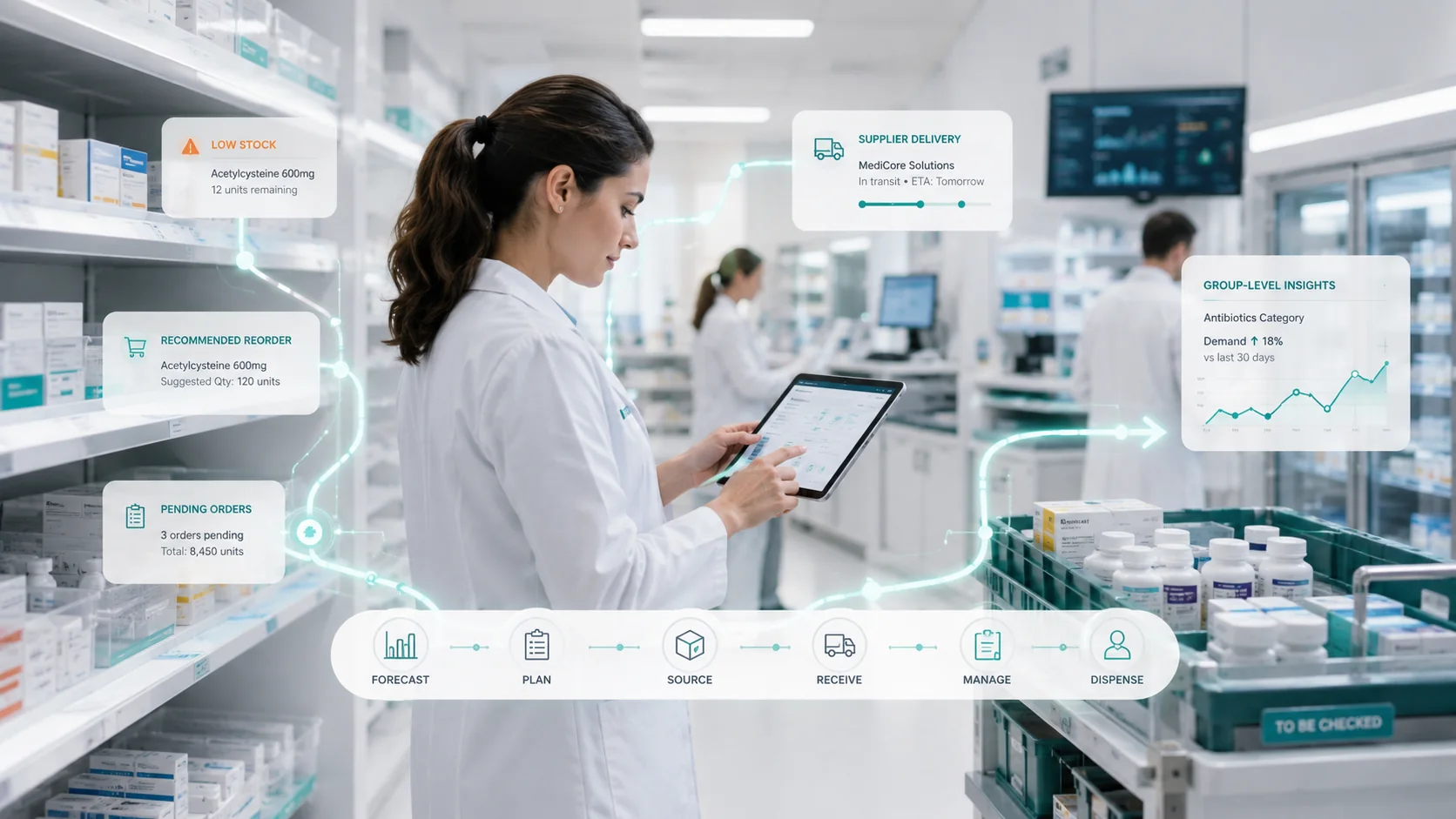
AI and medication management
Pharma Flow
R&D focuses on medicine-demand forecasting, inventory optimisation, shortage and expiry-risk reduction, order support, supplier communication automation and federated learning.
Explore Pharma FlowHistorical R&D experience
Software, devices and wireless communication
Earlier work combined software, devices, wireless communication, usability and the requirements of a hospital environment. It is presented here as historical research experience, not as an active product offer.
See the EU-funded project archiveInterdisciplinary capabilities
Our R&D team
We combine scientific and implementation perspectives and work with medical experts, research institutions and healthcare organisations so that technology assumptions can be confronted with domain knowledge and actual user workflows.
Meet the R&D team- artificial intelligence and machine learning
- data science, engineering and architecture
- databases and research methodology
- prototyping and R&D project management
- business and systems analysis
- software production
Responsibility matched to the project
Cooperation models
We can take responsibility for the complete path or for a clearly separated research, technology or implementation work package.
Complete R&D delivery
From concept and research through prototype development and implementation.
A selected task
Data preparation, AI model development, prototyping, integration or technical validation.
Consortium partner
Joint delivery with healthcare organisations, research institutions and businesses.
R&D contractor
Separated research or development work aligned with the plan, milestones and documentation requirements.
Implementation partner
We take research outcomes and turn them into a complete information solution prepared for real use.
Seven stages from question to implementation
How does the cooperation work?
The precise path depends on the problem and uncertainty, but every stage has an objective, evaluation criteria and documented outcome.
01 We analyse the problem
We learn about the process, users, available data, constraints and intended outcomes.
02 We formulate research questions
We define the uncertain element, hypotheses and assessment criteria.
03 We design the research
We prepare experiments, an environment, metrics and a schedule.
04 We build and compare solutions
We test alternative methods and document the results.
05 We create a prototype
We verify whether the method can work within the actual process.
06 We run a pilot
We validate the solution with users and domain experts.
07 We implement the results
We build the production solution, integrate it with systems and prepare it for maintenance.
For organisations facing genuine technological uncertainty
Who is this offer for?
We work with organisations that need a team capable of moving from a research question to implementation.
- hospitals and hospital pharmacies;
- other healthcare providers;
- universities and research institutions;
- technology companies and equipment manufacturers;
- healthcare businesses;
- consortia delivering R&D projects.
Begin with the problem, data and intended outcome
Let us discuss your research and development project
Do you have a problem that available products cannot solve, or data that could support a new model or service? Let us assess the research uncertainty and practical route to implementation.